|
|
|
|
|
|
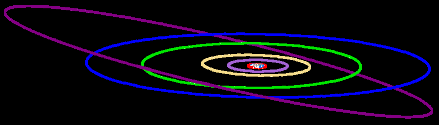
What is Gravity Simulator?Professional astronomers have many tools at their disposal. While you might think of an astronomer as someone who spends countless hours behind the eyepiece of a large telescope, many astronomers spend more time in front of a computer. Using computers, astronomers can model, study, and observe the universe in ways that are not possible with a telescope. Amateur astronomers, however, are often confined to observe only with telescopes.Gravity Simulator provides amateur astronomers with a powerful numerical integration tool. By performing n-body simulations, you can study the orbits of planets, moons, asteroids, or any object in the universe. You can recreate simulations performed by professional astronomers, or experiment with simulations of your own creation. Using Gravity Simulator's rotating frame feature, you can easily study the complex orbital relationship between the various moons of Saturn, or the relationship between Earth's orbit, and the horseshoe orbit of Cruithne, an asteroid often referred to as "Earth's 2nd moon". You can run the numerous simulations that come with Gravity Simulator, and additional ones available on this web site. Once you are comfortable with the existing simulations, you'll probably want to create some of your own. Gravity Simulator allows you to study the universe in a whole new way. Enjoy... There are two versions of this program.
The original version is only for Windows.
The latest version runs in your web browser, so it will run on any platform. It does not require Java or Flash.
NewOver your lifetime, the constellations will not change. But over long periods of time, they do! The Proper Motion Simulator will let you see every constellation change with time. It will even let you fly through the constellations!
|
|
|
|